

Cherith Sinasac Appears Before the House of Commons on Electric Vehicle Availability Standard
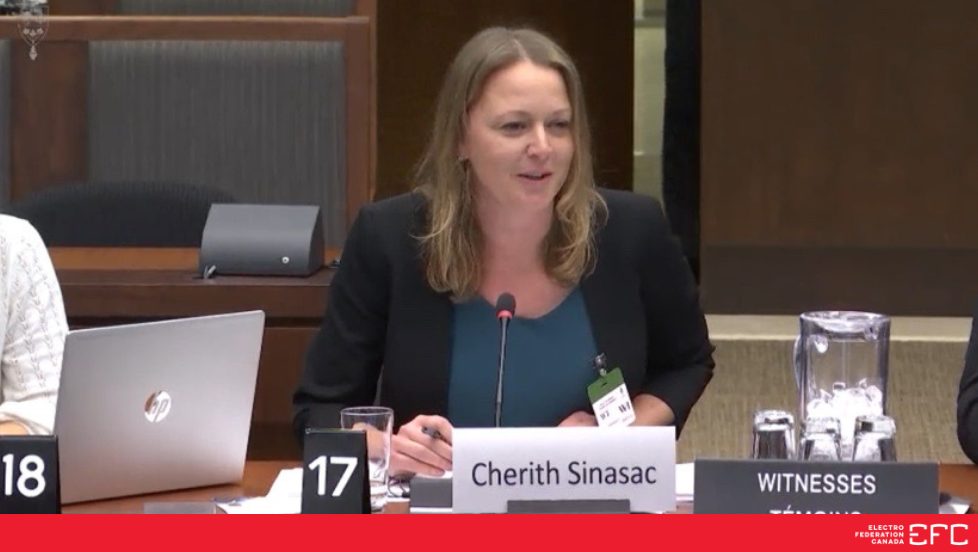
Electro-Federation Canada (EFC) was proud to represent the electrical and automation industry on Monday, November 24, when Cherith Sinasac, Director of Standards and Government Affairs, appeared before the House of Commons Standing Committee on Environment and Sustainable Development. Sinasac joined Evan Wiseman, Senior Manager of Climate Policy at The Atmospheric Fund, and Blandine Sebileau, Sustainable Mobility Analyst at Équiterre, to provide expert testimony on Canada’s Electric Vehicle Availability Standard (EVAS).
Speaking on behalf of EFC’s member companies, Sinasac highlighted the critical role electrification of transportation plays in meeting Canada’s 2050 net-zero commitment. She emphasized that EV adoption depends heavily on the availability, reliability, and accessibility of charging infrastructure, and that industry investment in this infrastructure requires clear and consistent long-term policy direction.
Drawing on the perspective of Canada’s globally integrated electrical supply chain, Sinasac explained that manufacturers around the world are competing to meet demand for chargers, transformers, switchgear, and other essential components. She noted that countries offering strong policy certainty receive priority in global allocation decisions. Without that certainty, Canada risks reduced product availability, leading to higher costs, longer lead times, and delays in essential infrastructure deployment.
Sinasac also cautioned that weakening or stepping back from the EV Availability Standard would undermine Canada’s competitiveness, stall private investment in charging infrastructure, and send negative signals throughout the supply chain.
As part of EFC’s submission, Sinasac recommended the federal government maintain the strength of EVAS and pause the requirement at the 2032 compliance ratio of 83 per cent. This, she stated, would give companies the confidence to invest in Canadian capacity while preserving consumer choice, including for those who are late adopters and want to continue purchasing internal combustion engine vehicles.
In closing, Sinasac reminded the Committee that the EVAS is not only an emissions measure, but also a critical economic and supply-chain signal that shapes how and where manufacturers invest. EFC appreciates the opportunity to take part in this important national discussion and recognizes Sinasac’s strong leadership in representing the voice of Canada’s electrical sector alongside other respected climate and mobility experts.
Watch the full Standing Committee on Environment and Sustainable Development meeting here.