

Canada’s Manufacturing Opportunity: From Investment Interest to Domestic Capacity
Canada is entering a period of significant investment in electricity infrastructure as governments, utilities and industry upgrade, expand and modernize the electricity system. That investment presents an opportunity to strengthen the domestic manufacturing capacity needed to support electrification and more resilient electrical supply chains.
Against this backdrop, Electro-Federation Canada (EFC) surveyed manufacturer members about current and planned investments, the factors influencing where they expand manufacturing operations, and Canada’s competitiveness relative to other jurisdictions.
The results point to a clear opportunity: Canada is attracting manufacturing investment but maintaining that position will depend on competitive investment economics and predictable access to the U.S. market.
Members are Investing—and Canada is Capturing Investment
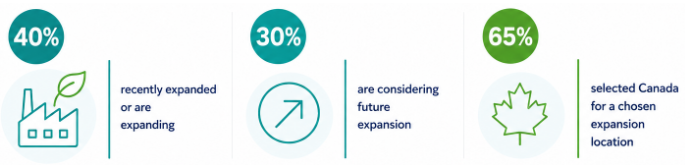
Forty per cent of respondents had recently expanded or were currently expanding at a location already selected, while another 30 per cent were considering future expansion.
Among the expansion locations already selected by respondents, 65 per cent were in Canada.
These findings demonstrate meaningful investment activity and interest. But attracting the next wave of investment will depend on the conditions manufacturers encounter when comparing Canada with competing jurisdictions.
Skilled Labour Leads Location Decisions
The availability of skilled labour was the most frequently selected factor influencing where manufacturers expand operations, cited by 71.4 per cent of respondents.
The cost of land and buildings followed at 52.4 per cent, while market access and proximity to customers ranked third at 47.6 per cent. Proximity to existing company operations, availability of engineers and technical talent, capital investment incentives and corporate tax rates were each cited by 38.1 per cent.
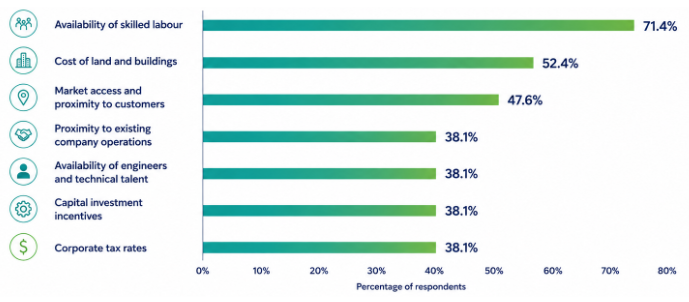
The results reinforce that manufacturing competitiveness extends beyond any single policy measure. Companies consider talent, costs, customers and investment conditions together when deciding where to deploy capital.
Canada Has Strengths—But Investment Economics Matter
EFC members see Canada and the United States as broadly comparable on several important fundamentals, including market access, transportation infrastructure and proximity to integrated supply chains.
Canada’s challenges are concentrated in the economics of investment, including land and building costs, capital investment incentives and corporate tax rates. The United States is viewed as particularly strong in these areas, while Mexico and parts of Asia compete primarily on labour costs.
Canada’s opportunity is to build on its position as a high-value North American manufacturing platform while improving the conditions that influence investment decisions.
Predictable U.S. Market Access is Essential
Market access is particularly important for electrical manufacturers. Seventy-one per cent of respondents manufacturing in Canada export to the United States.
Maintaining predictable access to the U.S. market is therefore central to investment confidence, plant utilization and the competitiveness of integrated North American supply chains.
While Canada cannot control the outcome of trade negotiations, governments can take steps to strengthen the domestic competitiveness and resilience of the manufacturing sector.
Investment Incentives Can Influence Decisions
The survey provides a particularly strong indication of the potential impact of investment incentives.
Among organizations considering a manufacturing investment, 76% said a manufacturing investment tax credit would moderately to significantly increase their investment in Canada.
EFC has advocated for manufacturing investment tax credits for critical grid and electrification products. If a technology is essential to delivering Canada’s clean electricity and electrification objectives, EFC believes the manufacturing equipment used to produce it should be eligible for the same investment tax treatment as other clean-economy technologies.
The Government of Canada has encouraged EFC members to consider the Strategic Response Fund when planning operational expansions in Canada. Investment tax credits can complement strategic government funding rather than replace it. Strategic programs, such as the Strategic Response Fund, can support selected capital-intensive projects, while predictable tax credits can improve the economics of a broader range of qualifying investments.
Canada has invested significantly in creating demand for electrification. Strengthening the capacity to deliver it is the next opportunity. Grid equipment and electrification manufacturers produce technologies that connect clean electricity to homes, businesses, electric-vehicle charging, data centres and industry.
A Practical Agenda for Canadian Competitiveness
The survey points to practical actions governments can take to strengthen Canada’s manufacturing competitiveness independent of CUSMA outcomes. EFC’s recommendations focus on investment incentives, harmonized domestic-content incentives, procurement, financing, industrial readiness, and corporate tax competitiveness.
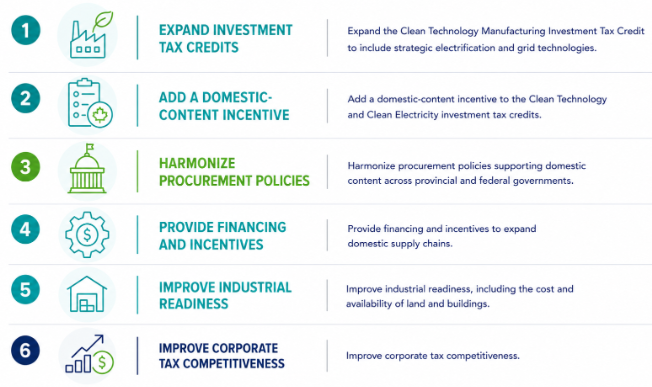
As the federal government prepares its next budget, EFC will use the Competitiveness Survey findings to inform its policy recommendations and ongoing engagement with Innovation, Science and Economic Development Canada, Finance Canada and provincial governments.
Planning an Expansion?
EFC members considering Canadian manufacturing investments can use the Government of Canada’s Business Benefits Finder to identify programs and services that may support their investment.
Thank you to the members who contributed their experience and perspectives to the survey. Member feedback helps EFC advocate for policies that support investment, strengthen domestic manufacturing capacity, and reflect the realities of electrical supply chains.
Source: EFC Competitiveness Survey 2026. Percentages reflect the respondent base for each question and may not sum to 100% where multiple responses were permitted.